

Feedstock suppliers
AfriSAF's farmer and aggregator network, delivering feedstock to a qualified, traceable standard.


AfriSAF's traceable feedstock feeds sustainable aviation fuel production through partnerships with production facilities - cutting lifecycle emissions against conventional jet fuel and creating a new market for Africa's agricultural byproducts.
Sustainable aviation fuel isn't a different kind of engine or a new type of aircraft - it's jet fuel made from a different carbon source. Production takes a feedstock like agricultural residue or waste oil and rebuilds it, molecule by molecule, into a hydrocarbon that behaves the same as fossil jet fuel in the same engines and the same airport infrastructure.
AfriSAF's role sits at the front of that process: supplying certified, traceable feedstock into conversion through partnerships with production facilities, rather than operating refineries of its own. The fuel chemistry is well established - what the industry is short of is feedstock that can be proven sustainable.
Of the eleven conversion pathways approved under ASTM standards so far, HEFA - Hydroprocessed Esters and Fatty Acids - is the most widely deployed. It works in two core steps: hydrotreatment strips oxygen out of the oils and fats under high heat and pressure, then hydroisomerization cracks and reshapes the remaining long carbon chains into the shorter, branched molecules that jet fuel needs.
The result typically cuts lifecycle emissions by around 80% against conventional jet fuel. Global HEFA capacity is set to reach roughly 2.2 million tonnes in 2026 as facilities in Rotterdam and Singapore come online - capacity that needs feedstock behind it.
AfriSAF's farmer and aggregator network, delivering feedstock to a qualified, traceable standard.

Refiners running the HEFA conversion that turns feedstock into jet-range hydrocarbons.

ASTM for fuel specification, RSB and ISCC for the sustainability claim behind it.

Buying certified fuel and blending it into existing operations without new infrastructure.


Before anything reaches a refinery, the feedstock has to clear both bars: the chemical one and the sustainability one. Lab testing establishes composition and impurity levels, while the traceability record establishes where it came from.
 Composition & impurity testingPre-treatment to producer specOrigin records attached to every lot

The first conversion step. Under high heat and pressure with hydrogen, oxygen is stripped out of the triglycerides in the feedstock - leaving straight-chain hydrocarbons and removing the instability that oxygen would otherwise carry into the fuel.
Hydrodeoxygenation of triglyceridesDouble bonds saturated for stabilityStraight-chain paraffins produced

Those long, straight chains are then cracked and reshaped into the shorter, branched molecules that sit in jet fuel's carbon range. Distillation separates the output into jet, naphtha, and diesel fractions - the jet cut being the one that matters here.
Cracking to jet-range chain lengthIsomerization for cold-flow performanceSeparation into jet, naphtha & diesel cuts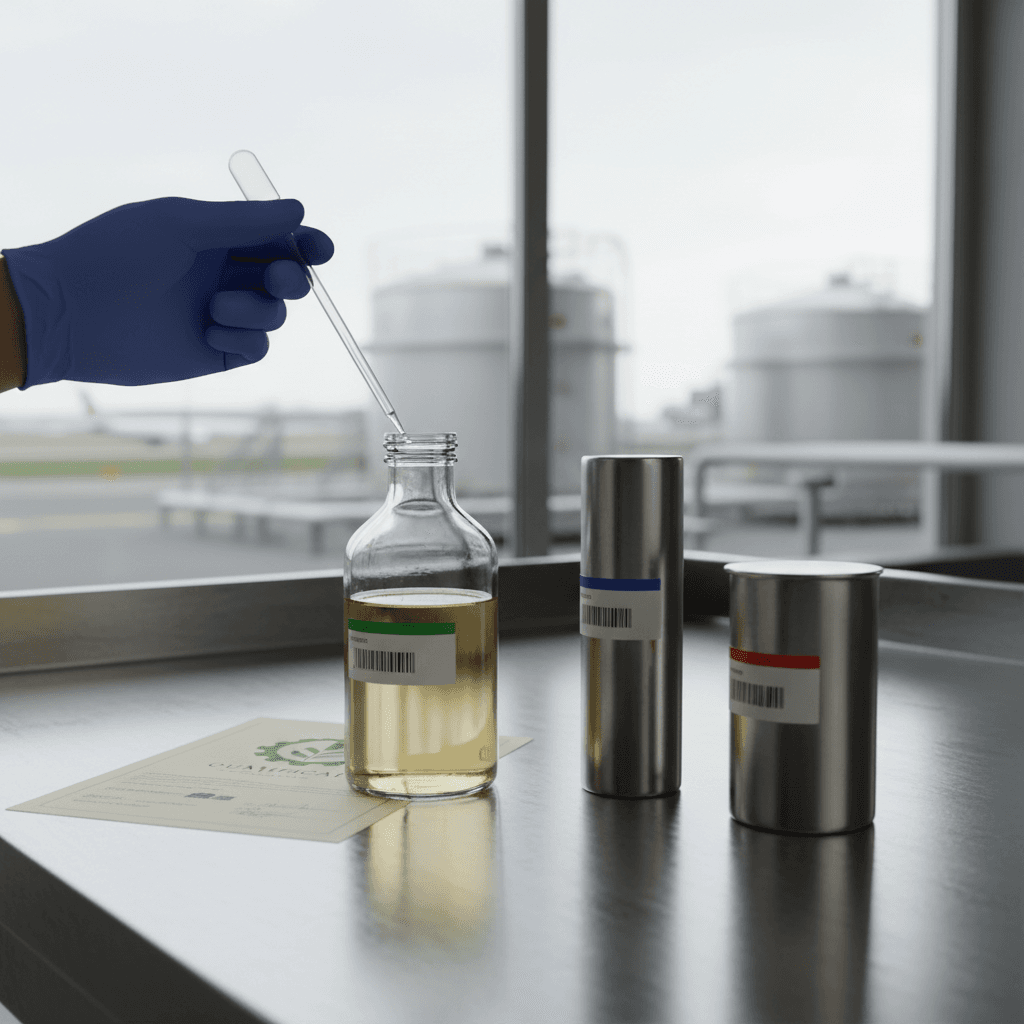

The finished fuel is qualified against ASTM D7566, the specification for jet fuel containing synthesized hydrocarbons, then blended with conventional Jet A up to the approved limit - at which point it re-certifies as ordinary jet fuel and needs no separate handling at the airport.
Alongside that sits the sustainability claim: proof, not assertion, that the feedstock behind the fuel was genuinely residue-based. That's the record Verifeed builds, aligned to RSB and ISCC.
ASTM D7566 fuel qualificationBlended into Jet A up to 50%RSB & ISCC sustainability proof
If you're producing sustainable aviation fuel and need traceable feedstock behind it - or buying fuel and need proof of where it came from - let's talk.